Before I Begin: The views represented here are my own and have never been views of my employer(s). Last Updated: June 20, 2026
List of government design systems
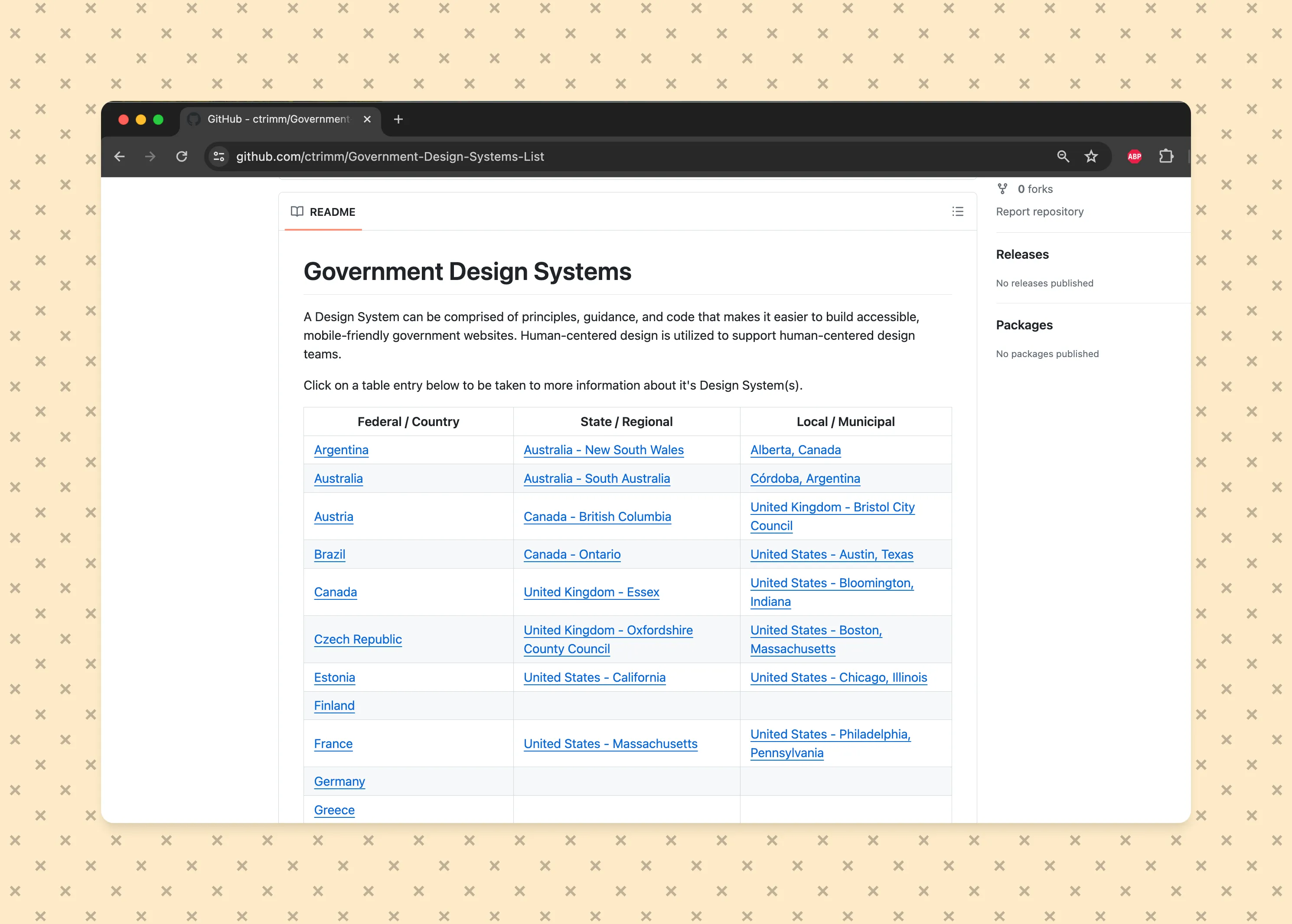
Cut to the chase - the GitHub Repository with a List of Government Design Systems is here.
What is a government design system
As classically defined, a Design System is:
A design system is a collection of reusable components and clear standards that can be assembled together to build any number of applications. Design systems aid in digital product design and development of products such as mobile applications or websites. Source: Wikipedia
There isn’t much to debate here, the government tends to stick to the above definition for what a Design System is and how teams can/should utilize it. There may, however, be multiple design systems within a Department/Entity if there are different user-facing applications (i.e. end-users v. internal-only users v specific workplace setting). You can even see this within the United Kingdom with the National Health Service having their own Design System and smaller towns having their own.
Why create a list of government design systems?
Initially, I set out on this as a way to determine who is utilizing Web Components within their Design System. Web Components are a way to encapsulate a set of features allowing you to use them in microfrontends - regardless of the Javascript Framework. My thinking here was that if development teams created Web Components, various departments would not be married to a singular application framework and could start to build in consistency across applications with different technologies.
However, it’s since expanded a bit into a broad list of Design Systems exist at the Federal/Country, State/Regional, and Local/Municipal level.
Currently, there are over 230 known Government Design Systems chronicled on the GitHub Repository — up from 37 when this post was first published in 2024. The list has grown substantially, spanning 70+ Federal/Country-level systems, 50+ State/Regional systems, and 10+ Local/Municipal systems across six continents. New entries continue to be added as more governments publish their design systems publicly.
What’s New (2025–2026)
A lot has changed since the original post. Some notable updates from the repo:
- Delaware launched the Lighthouse Design System in January 2025, built on WordPress.
- Malaysia completed the full launch of MYDS (My Design System) in April 2025.
- Cyprus released v3.2.0 of their design system in April 2025, with automated accessibility tests via pa11y.
- United Arab Emirates updated to v2.3.0, now fully WCAG 2.2 compliant and built with TailwindCSS.
- Philippines passed the E-Governance Act in September 2025, mandating a unified eGov PH platform.
- Mongolia launched E-Mongolia 5.0 in September 2025, integrating 1,278 government services.
- Canada - British Columbia paused development of their design system in February 2025.
- United Kingdom completed a WCAG 2.2 AA audit of GOV.UK Frontend in July 2024.
Broader trends
A few patterns have emerged across the list as of mid-2026:
- Web Components adoption is growing. Brazil, Cyprus, France, the Netherlands, the UAE, the UK Intelligence Community design system, and the US VA design system all ship Web Components alongside (or instead of) framework-specific libraries.
- Figma is now the dominant design tool. Over 70% of the systems in the list now include a Figma UI kit or resource.
- Accessibility standards are increasingly mandatory, not aspirational. Around 80% of tracked systems require WCAG 2.1 AA compliance or a local equivalent by law or policy.
Current Detail View
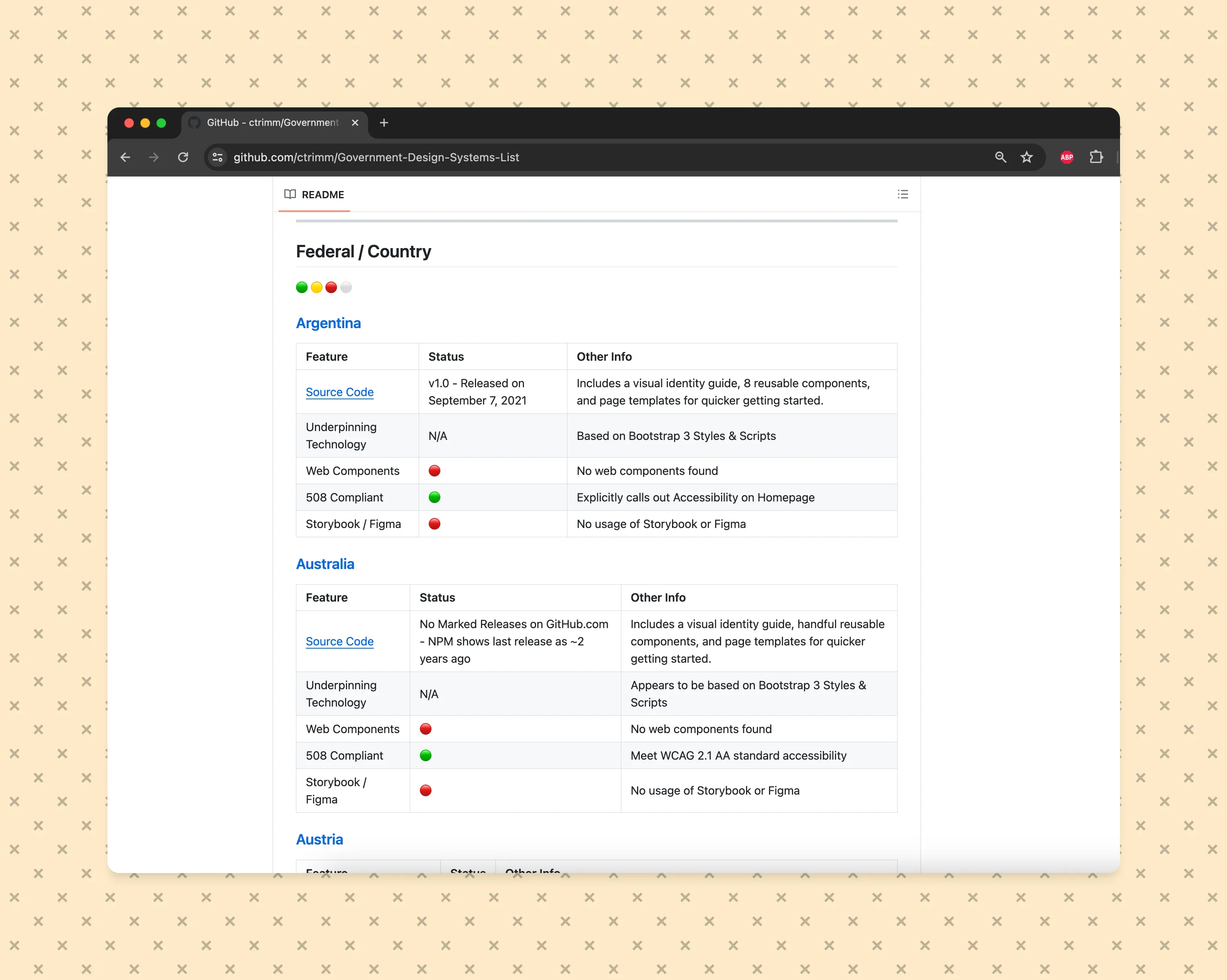
The review process takes a bit of time for each Government Design System since there is not a standardized way that the documentation is written. Sourcing whether or not components in the design system are a11y friendly / 508 compliant often takes some manual work to explore. Finding out other information like if there is a Storybook / Figma page requires in depth reading of the documentation.
Perhaps there is a way to expedite this process in the future, but now that the list has grown to 230+ entries there is even more reason to look for ways to automate some of that cataloguing work.
By collecting this information, I feel that it can help other digital service or delivery teams that operate in the public sector reuse existing technologies to expedite delivery.
How to contribute to the list
Adding a new design system
If you know of a government design system that is not currently listed in this repository, please create a new issue with the details. Include as much information as possible, such as the name of the government entity, a link to the design system, and any other relevant information.
Reporting bugs
If you find any bugs or issues, please create a new issue in the issue tracker. Describe the issue in detail so we can reproduce it and fix it.
Suggesting enhancements
If you have an idea for a new feature or an enhancement to an existing one, please create a new issue in the issue tracker. Describe your idea in detail so we can discuss it further.
Further Reading
- GitHub Repository of Government Design Systems
- Local Government Design Systems Repository by Ron Bronson - Last Updated February 22, 2020
- Hacker News Comment on “The impact of removing jQuery on our web performance”
- Platformland Government Design Systems Repository Table - Last Updated May 19, 2022
- State Design Systems List (Twitter)
- And probably countless google queries
Related Posts
- Tracking Estimated Website Carbon Emissions for 15,000+ Gov DomainsRead how I used GitHub Actions, puppeteer, and other tech to hack together a site in ~3 hours to track Estimated Website Carbon Emissions for Federal Websites.4/21/2024
- What I wish someone told me before going into gov techThis is my take on another blog post titled 'What I Wish Someone Had Told Me' but after spending 4+ years in the Public Sector at the VA.5/5/2024
- Backstage software template repositorySolving a need that was discussed on Hacker News to put as many Software Templates for Backstage into a single place for other teams to use5/7/2024